Understanding Radon
Understanding Radon: The Invisible Risk Every Home Should Test For
Radon is a naturally occurring radioactive gas produced by the breakdown of uranium in soil and rock. It is colourless, odourless, and tasteless — and the only way to know your home's level is to test.
What is radon
A Naturally Occurring Gas That Accumulates Indoors
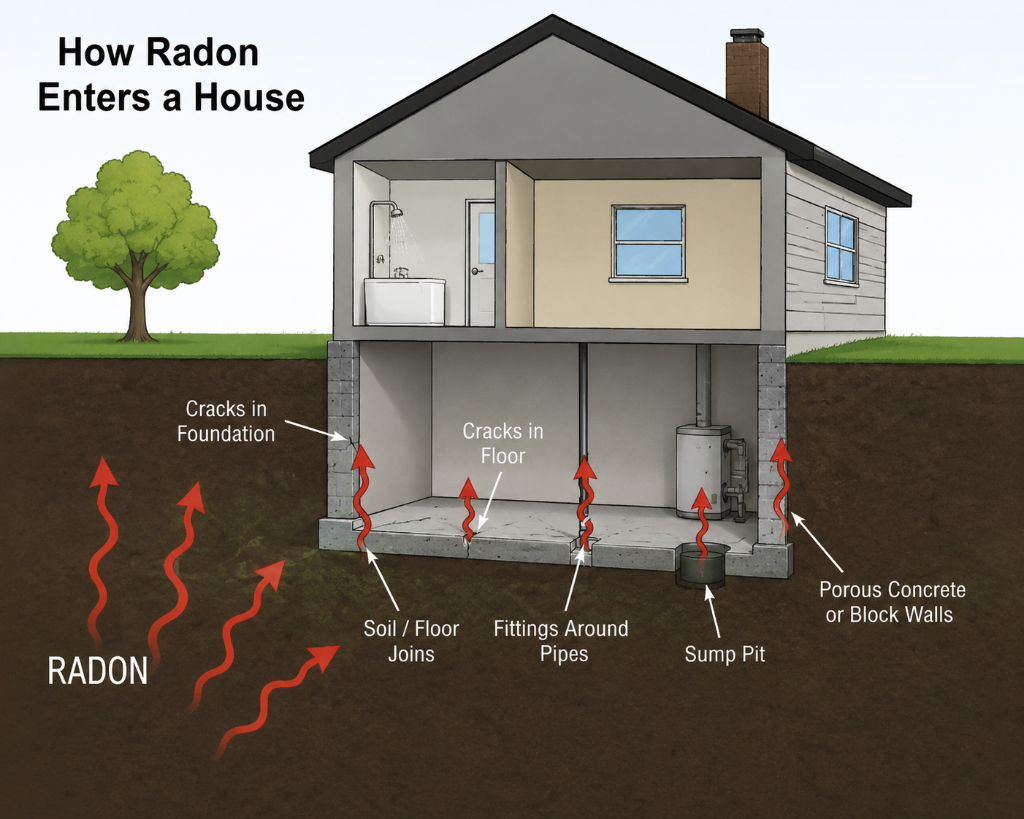
Radon forms naturally when uranium in soil, rock, and groundwater breaks down. Outside, radon disperses harmlessly. Indoors, it can accumulate — especially in lower levels with limited air exchange. Because every home is built differently, sits on different geology, and ventilates differently, radon levels vary significantly from house to house and even floor to floor.
Guideline reference levels
Health Canada
Action guideline
Health Canada recommends taking action to reduce radon levels when long-term concentration exceeds this level.
World Health Organization
Reference level
The WHO suggests 100 Bq/m³ as a reference level, acknowledging that even lower levels carry some degree of risk.
Guidelines are for reference only. RBM does not provide medical advice. Testing and mitigation decisions should be based on measured results and professional guidance.
For official public-health information about radon in Canada, visit Health Canada radon information.
Why every home is different
Geology, Foundation, and Ventilation All Affect Radon Levels
Geology
Uranium content in underlying rock and soil varies by region, affecting how much radon is generated.
Foundation type
Slab, basement, crawlspace, and block foundations all provide different entry opportunities.
Ventilation patterns
How air moves through a home, including stack effect and HVAC operation, influences how radon accumulates.
Soil permeability
Porous soils allow more radon movement toward the home; clay soils can restrict or redirect it.
Test First. Mitigate If Needed.
Testing gives you a real number. If that number is within an acceptable range, you have peace of mind. If it is elevated, radon mitigation can address the source and reduce exposure. RBM provides a clear path either way.
Related Information
Take the first step
Ready to Test Your Home for Radon?
RBM uses professional-grade diagnostics to measure what is happening inside your home, then recommends targeted solutions based on real data.